
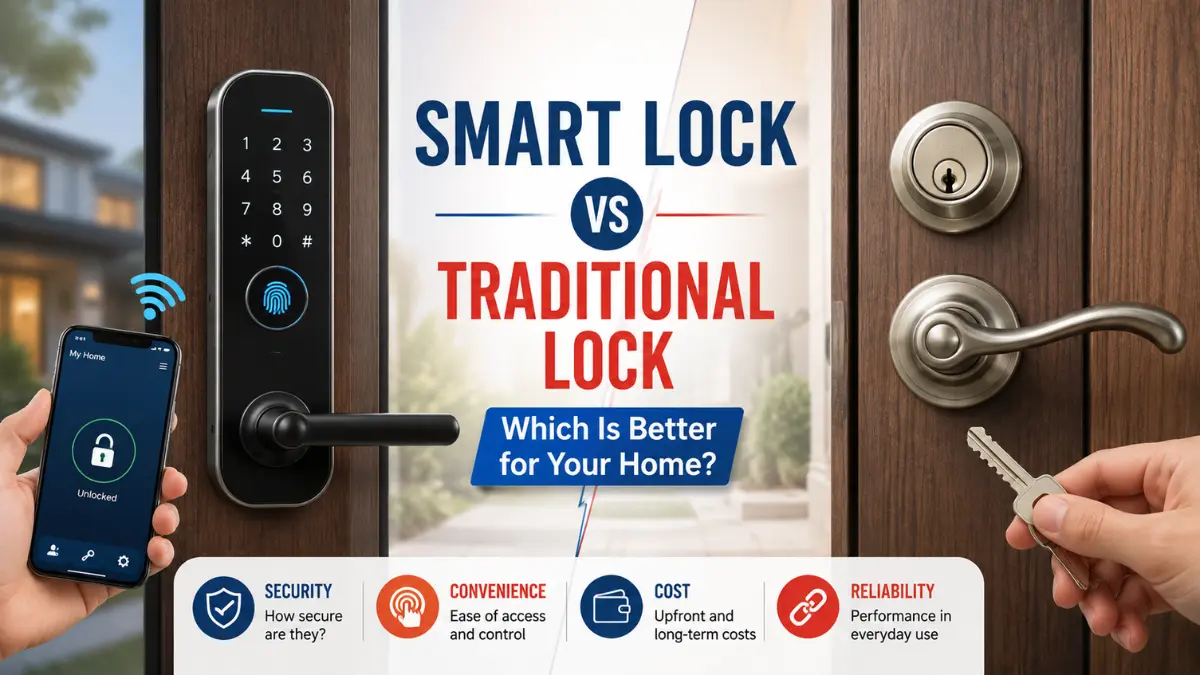
Choosing between a smart lock vs traditional lock is not just about technology. Both can secure your home, but they differ in security, convenience, cost, reliability, maintenance, and access control.
A smart lock can offer PINs, fingerprints, smartphone access and temporary entry codes, while a traditional lock relies on a physical key and mechanical locking system.
In this guide, we compare smart locks and traditional locks to help you decide which is better for your home, with practical considerations for homeowners in India, the UK and the US.
Quick Answer: Neither is automatically better. A smart lock is a better choice if you want keyless entry, remote access and flexible access control. A traditional lock may be better if you prefer simplicity, lower cost and a locking system that does not depend on batteries, apps or connectivity.
The right choice depends on your security needs, door type, budget, maintenance preferences and how you use your home.
Smart Lock vs Traditional Lock: What’s the Difference?
A smart lock uses electronic technology to control access through methods such as PIN codes, fingerprints, smartphones, RFID/NFC credentials or connected devices. A traditional lock primarily uses a mechanical key and locking mechanism.
The main difference is how access is authenticated and managed. Smart locks can provide keyless entry and user management, while traditional locks offer a simpler mechanical system without batteries, apps or network connectivity.
Smart Lock vs Traditional Lock: Core Comparison
The main differences between a smart lock and a traditional lock involve security, convenience, access control, cost and reliability. Neither type is automatically more secure; the right choice depends on the complete door-security system and how the lock will be used.
| Factor | Smart Lock | Traditional Lock |
|---|---|---|
| Security | Mechanical and electronic security | Primarily mechanical security |
| Convenience | Keyless and flexible access | Simple key-based access |
| Access control | PINs, biometrics, apps and other credentials | Usually controlled by physical keys |
| Cost | Generally higher upfront cost | Generally lower upfront cost |
| Reliability | Depends on the model, battery and electronics | Less dependent on electronics or power |
Security: Which Is Actually More Secure?
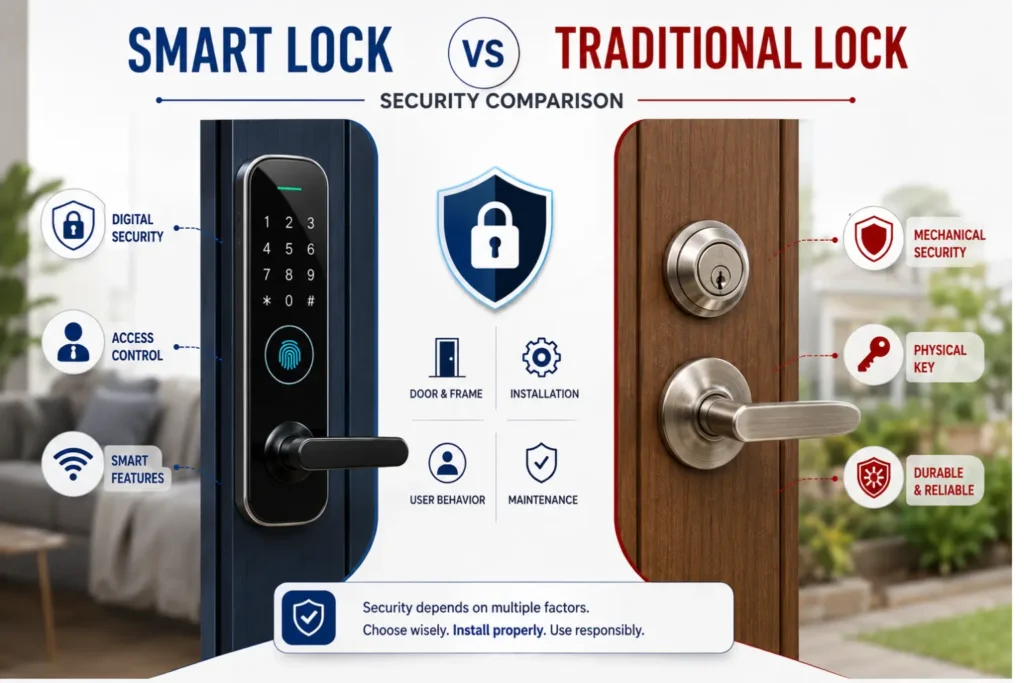
Neither a smart lock nor a traditional lock is automatically more secure. Real-world security depends on the locking mechanism, door and frame, installation quality, authentication controls and how the system is used and maintained.
Mechanical Security
Both lock types ultimately rely on a physical locking mechanism to resist forced entry. The cylinder, deadbolt or mortise mechanism, strike area, door, frame and installation can have a major impact on overall security.
A smart lock with advanced electronic features can still have a weak mechanical foundation. Similarly, a traditional lock with a strong locking mechanism can provide substantial physical resistance without using electronic technology.
Traditional mechanical locks are not immune to physical attack. Depending on the lock design and quality, some cylinders may be vulnerable to techniques such as picking, bumping or drilling. The overall strength of the door, frame, strike area and locking hardware should therefore be considered alongside the lock cylinder.
Digital Security
Smart locks add another security layer because access may involve PINs, fingerprints, smartphones, apps, Bluetooth, Wi-Fi or other digital credentials. These features can improve access control but also introduce additional considerations such as account protection, software security and credential management.
Smart locks have a different risk profile rather than being automatically more or less secure. Depending on the product and its design, potential risks can include signal-based attacks, weak authentication, compromised user accounts or poorly managed credentials. Security features such as encryption, multi-factor authentication and firmware updates can help reduce these risks when supported and properly maintained. The NIST consumer IoT cybersecurity guidance provides a useful framework for evaluating cybersecurity considerations in connected consumer devices.
How Lock Standards and Ratings Help Compare Security
Product standards and performance ratings can provide useful information when comparing locks, but the applicable system varies by market. Buyers may encounter BIS/IS standards in India, BS/EN standards in the UK and ANSI/BHMA standards in the US.
When comparing products, check the manufacturer’s stated certification or performance rating and make sure it applies to the specific lock, hardware and intended application. A rating should be considered alongside the door, frame and installation rather than as a guarantee of overall security. For example, the ANSI/BHMA A156.39-2025 standard establishes performance requirements for residential locksets and latches, including durability and security testing.
UK Insurance and Lock Requirements
In the UK, some home-insurance policies may specify particular lock types, security standards or approved hardware. Before replacing an existing lock, check your insurance policy requirements and verify that the proposed lock meets any applicable conditions.
Note: A sophisticated smart lock cannot compensate for a weak door, frame or poor installation. Evaluate the complete door-security system, including the lock mechanism, hardware, installation and applicable requirements.
Convenience, Access Control and Smart-Home Integration
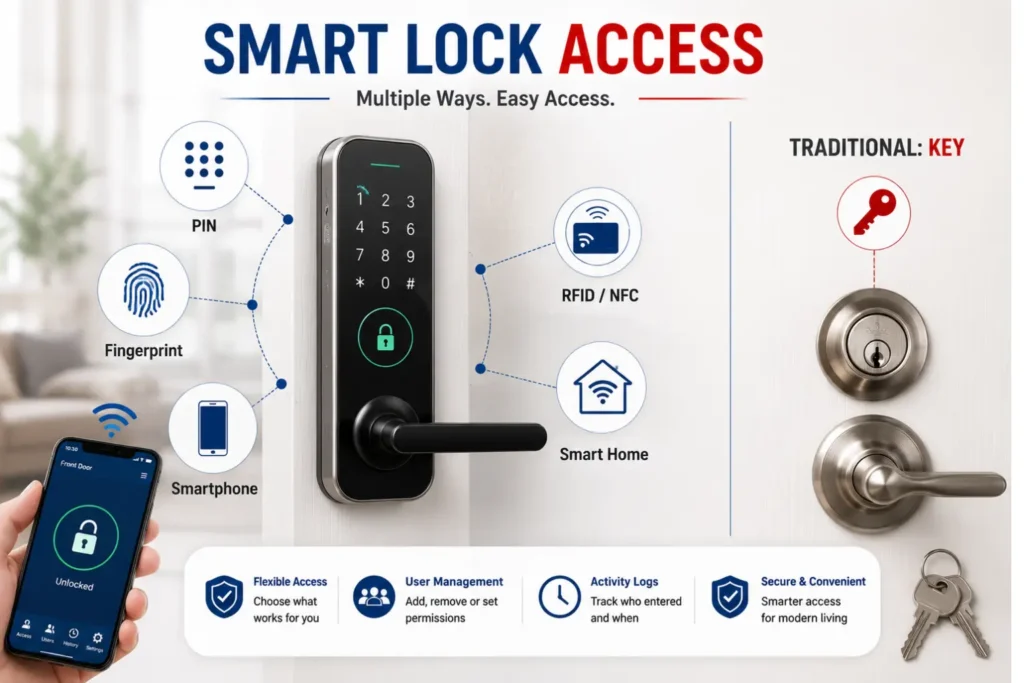
One of the biggest differences between a smart lock and a traditional lock is how access is provided and managed. Smart locks can support multiple digital credentials, while traditional locks generally rely on physical keys.
Smart Lock Access
Depending on the model, users may unlock the door with a PIN, fingerprint, smartphone, RFID/NFC credential or physical key. Some models also support temporary access, scheduled credentials and user management. For a detailed comparison of fingerprint and PIN authentication, see our Fingerprint and PIN code smart lock guide.
Compatible smart locks may also offer features such as remote lock or unlock, access notifications and activity logs. These features can make it easier to manage household members, guests or service providers, although availability varies by model and connectivity setup.
Smart-Home Integration
Some smart locks can integrate with smart-home platforms such as Amazon Alexa, Google Home, Apple Home or Matter. Compatibility can allow the lock to work with other connected devices and automation routines, but supported platforms and features vary by product.
Smart-home integration should be treated as a convenience feature rather than a guarantee of better security. Before buying, check the supported ecosystem, connectivity requirements and available access controls for the specific lock.
Because smart locks can use different connectivity technologies for these features, see our Wi-Fi vs Bluetooth vs Matter Smart Locks guide for a detailed comparison of Bluetooth, Wi-Fi and Matter connectivity.
Traditional Lock Access
Traditional locks usually provide straightforward key-based access. Additional users normally require duplicate keys, and removing someone’s access may require collecting or replacing the keys or changing the lock.
Key Takeaway: Smart locks generally offer more flexible access management and smart-home integration, while traditional locks offer simpler key-based operation with fewer electronic dependencies.
Power, Battery and Internet Dependence
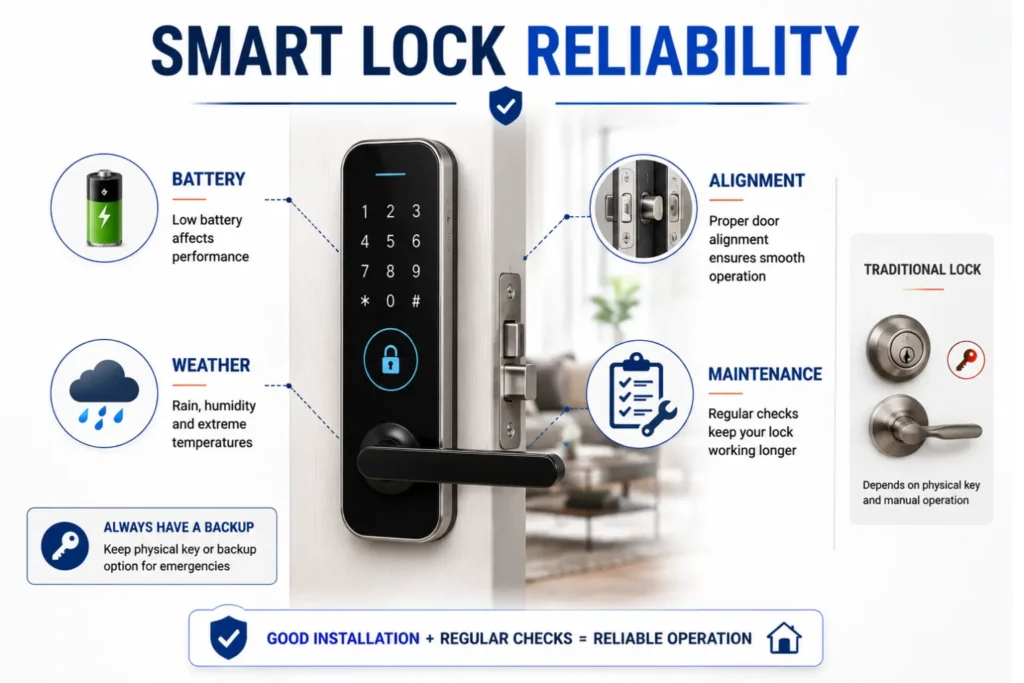
A key difference between smart locks and traditional locks is their dependence on electronic power and, for some models, connectivity. Most residential smart locks use batteries, while traditional mechanical locks generally do not require electrical power.
What Happens When the Battery Runs Low?
Smart locks may provide low-battery warnings, and battery performance can vary depending on usage, connectivity, temperature and the specific lock. For a detailed explanation of smart lock battery life, including common causes of battery drain and ways to extend battery runtime, see our dedicated guide.
Different models may offer emergency access through a physical key, external power or another manufacturer-supported method. Always understand the backup method before relying on a smart lock.
Does a Smart Lock Need Wi-Fi?
Not necessarily. Some smart locks can perform basic unlocking through Bluetooth, PINs or fingerprints without an active internet connection. Wi-Fi is generally needed for features such as remote access, depending on the product and its system architecture.
Note: Battery failure, internet outage and power-grid failure are different situations. Check the manufacturer’s documented emergency procedure for your specific smart lock.
Reliability, Installation, Maintenance and Service Life
The long-term reliability of a smart lock or traditional lock depends on the quality of the hardware, installation, usage, environment and maintenance. Neither type should be judged by its technology alone.
Smart Lock Reliability
Smart locks have additional components such as batteries, electronic circuits, sensors and motorized mechanisms. Battery condition, software support, door alignment and environmental conditions can affect their operation.
Environmental exposure also varies by region. In India, humidity and monsoon conditions can be important considerations for smart locks installed on exposed or semi-exposed doors. In the UK, damp and cold weather can affect outdoor installations, while in parts of the US, very hot or cold temperatures can influence battery performance and electronic components.
Before buying, check the manufacturer’s stated weather, environmental or ingress-protection rating, where provided, and make sure it is appropriate for the actual location of the lock.
Traditional Lock Reliability
Traditional locks have fewer electronic dependencies, but their mechanical components can still wear over time. Keys, cylinders, latches, deadbolts, hinges and other hardware may require maintenance, adjustment or replacement.
Installation and Long-Term Performance
Correct installation has a direct effect on long-term reliability, regardless of lock type. A smart lock that is not installed or calibrated correctly, or a traditional lock that is misaligned with the strike plate, can develop operating problems even when the hardware itself is good quality.
For a detailed walkthrough, see our Smart Lock Installation Guide.
Note: A lock’s service life varies by product, usage and environment. Regularly check the door alignment, locking mechanism and surrounding hardware regardless of lock type.
Cost and Total Cost of Ownership
The upfront price is one of the clearest differences between a smart lock and a traditional lock. However, the total cost can also include installation, replacement parts, batteries, maintenance and other accessories.
| Cost Factor | Smart Lock | Traditional Lock |
|---|---|---|
| Initial purchase | Generally higher | Generally lower |
| Installation | Depends on lock type and door compatibility | Usually simpler and less expensive |
| Ongoing costs | Batteries and possible maintenance or replacement parts | Usually limited to mechanical maintenance or replacement |
| Additional features | Some models may require hubs or compatible accessories | Usually no electronic accessories required |
What Should You Compare Before Buying?
Compare the lock price, installation cost, battery requirements, maintenance, replacement parts and expected service life rather than choosing only by the initial purchase price.
Note: Smart-lock prices and installation costs vary significantly by country, lock type, brand and door configuration. Always verify current local pricing before making a purchase.
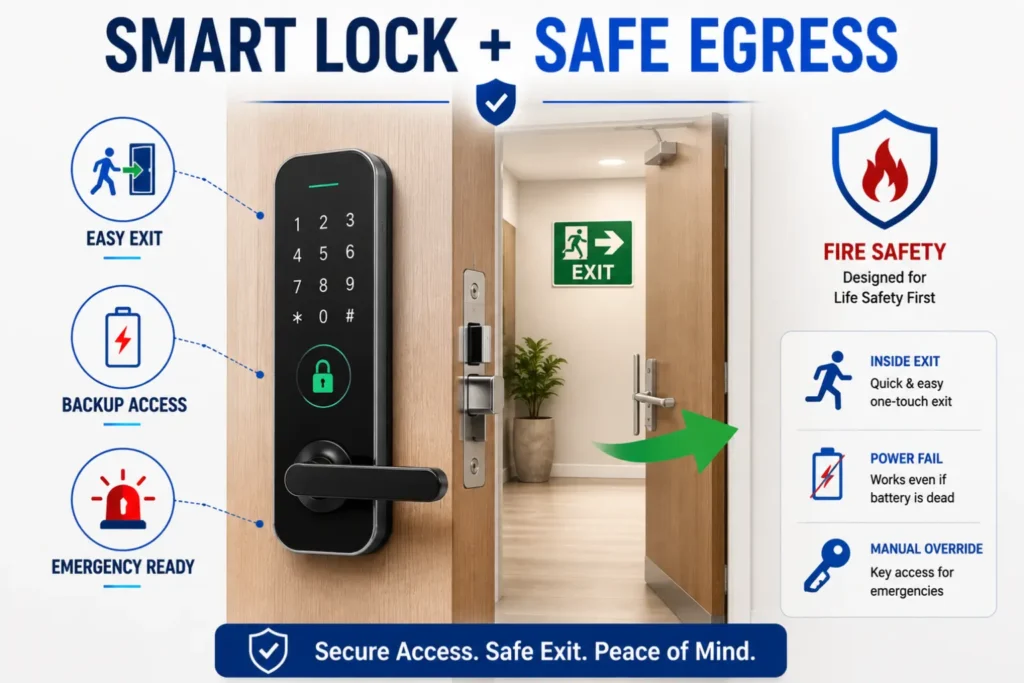
Emergency Egress and Fire Safety
A door lock should not only prevent unauthorized entry; it should also allow authorized occupants to exit safely during an emergency. This is an important consideration when comparing smart locks with traditional locks.
For doors that form part of an escape route or emergency exit, the locking arrangement should be evaluated for safe egress. A lock that requires a phone, battery, network connection, or difficult procedure to exit can create an unnecessary risk during an emergency.
Smart Locks and Emergency Exit
Before installing a smart lock, check how the door can be opened from the inside when the battery is depleted, electronics fail, connectivity is unavailable, or an emergency occurs. The manufacturer’s documented emergency-release method should be understood by all authorized occupants.
Traditional Locks and Emergency Exit
Traditional locks can also create egress concerns if occupants need a key or a special operation to unlock the door from the inside. The suitability of a locking arrangement depends on the door’s location, use, occupancy and applicable safety requirements.
India, UK and US Requirements Can Differ
Building and fire-safety requirements for emergency exits vary by country, building type, occupancy and local regulations. For an escape-route door, verify the applicable requirements before replacing or modifying the existing locking system.
For additional technical context on access-controlled locking and emergency egress, see UL Solutions’ guidance on locking configurations for access and egress control.
Key Takeaway: Never choose a lock only for its security features. For an escape-route door, safe and reliable emergency egress must remain a priority.
Privacy and Digital Security
Smart locks can collect and process more information than traditional locks, particularly when they use a smartphone app, cloud service, access logs or biometric authentication. This makes privacy and account security important parts of the buying decision.
Smart Lock Privacy
Depending on the model, information may include user accounts, access events, device information, fingerprints or other credentials. Before buying, check what data the manufacturer collects, where it is stored and how users can manage or delete it.
Account and App Security
If a lock uses an app or online account, protect it with a strong unique password, supported authentication controls and current software. Remove access for users who no longer need it and keep the manufacturer’s application and firmware updated.
For a broader explanation of smart lock hacking risks, privacy, authentication, physical security and how these security layers work together, see our Are Smart Locks Safe? Hacking, Privacy & Security Explained guide.
Traditional Lock Privacy
Traditional locks generally do not require an online account or cloud service to operate. Their main access credential is the physical key, although key management and duplication still need to be controlled.
Note: A smart lock’s privacy depends on its specific hardware, software and manufacturer’s data practices. Always review the product’s privacy policy and security documentation before connecting it to your home network.
Which Lock Is Right for Your Home?
The best choice depends on your security priorities, budget, access needs, door setup and willingness to manage electronic features. There is no single lock type that is ideal for every household.
| Situation | Better Direction | Why |
|---|---|---|
| Budget-conscious homeowner | Traditional | Usually lower upfront cost and simpler maintenance. |
| Multiple household users | Smart | Supports flexible credentials on compatible models. |
| Frequent guests | Smart | Temporary or user-specific access may be available. |
| Remote access required | Smart | Compatible connected models can support remote features. |
| No battery dependence preferred | Traditional | Mechanical operation generally does not require electronic power. |
| Rental property | Depends | Check landlord permission, door compatibility and local requirements. |
| High-security home | Depends | Evaluate the complete door, frame, lock and installation. |
| Escape-route door | Safety requirements first | Reliable emergency egress should take priority over convenience. |
Key Takeaway: Choose the lock based on your actual access needs, door-security requirements and emergency egress rather than choosing smart or traditional technology simply because it is newer or cheaper.
Smart vs Traditional vs Hybrid
You do not always have to choose between a smart lock and a traditional lock. A hybrid approach can combine electronic access with an appropriate mechanical backup, depending on the door, lock design and security requirements.
| Approach | Main Advantage | Best Suited For |
|---|---|---|
| Smart lock | Keyless access and flexible access management | Homes needing multiple access methods or connected features |
| Traditional lock | Simple mechanical operation | Users prioritizing simplicity and minimal electronic dependency |
| Hybrid approach | Convenience with an appropriate mechanical backup | Homes wanting smart features while retaining a fallback access method |
When a Hybrid Approach Makes Sense
A hybrid setup may be useful when occupants want keyless convenience but also need a dependable alternative if the electronic system, battery or connected features become unavailable.
However, adding a second lock does not automatically make a door more secure. The complete locking arrangement should remain compatible with the door, frame, emergency egress requirements and intended use.
Note: A mechanical backup is useful only when it is properly designed, accessible to authorized users and compatible with the specific smart-lock system.
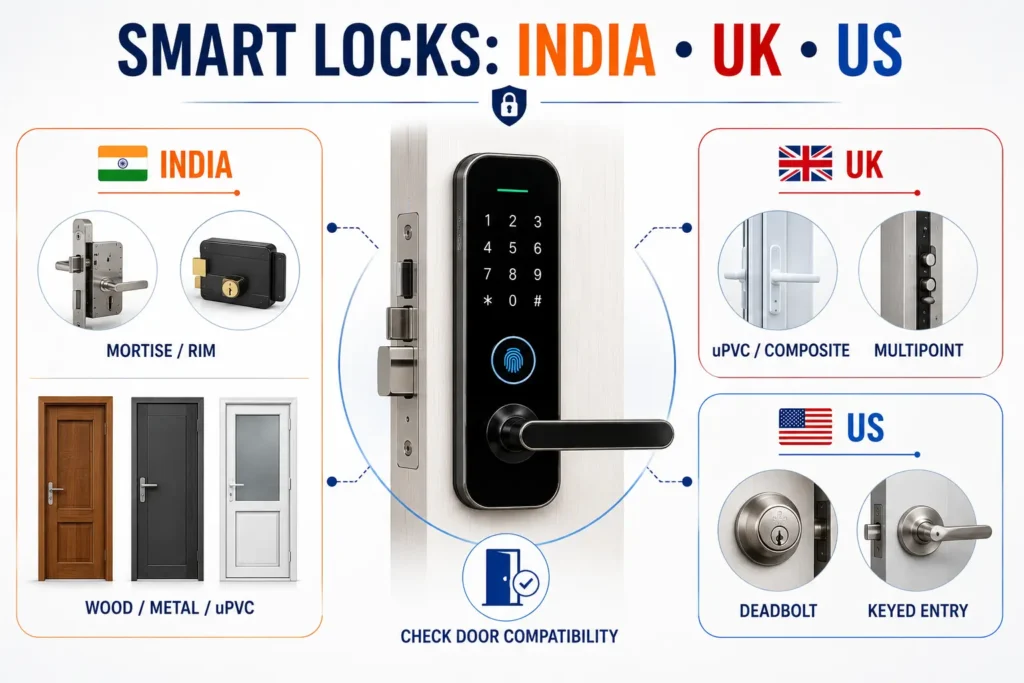
Smart Lock Considerations in India, the UK and the US
Choosing a smart lock can involve different considerations depending on the market. Door designs, existing lock hardware, terminology, installation practices and applicable requirements vary between India, the UK and the US.
India
Indian homes commonly use mortise and rim locks across a wide range of doors, including solid wood or teak main doors, flush doors, metal, aluminium and uPVC doors. Before buying, check the existing lock mechanism, door dimensions, installation requirements and environmental conditions.
India also has BIS standards covering different types of lock hardware. Buyers can check the BIS Know Your Standard portal for applicable Indian Standards and product information. For electronic locking products, BIS currently lists IS 19461:2025 for electronic locks for security equipment.
See our Smart Locks Guide for a detailed compatibility overview.
UK
UK homes may use uPVC and composite doors, multipoint locking systems, euro cylinders, mortice locks and other hardware configurations. Smart-lock compatibility therefore depends heavily on the existing locking mechanism and door configuration.
Buyers should also consider applicable building, fire-safety, security and insurance requirements before replacing a lock. For fire-safety requirements in England, refer to the current GOV.UK Approved Document B and verify requirements relevant to the specific building and door.
US
US residential doors commonly use deadbolts and keyed entry hardware. Before choosing a smart lock, check the existing lock configuration, door thickness, backset and installation requirements.
Buyers may also want to consider applicable lock-performance standards and smart-home compatibility when comparing products. The specific requirements can depend on the type of door, building and intended application.
Note: Regional terminology, door hardware and security requirements can differ. Always verify the specific door, existing lock mechanism and applicable local requirements before purchasing or installing a smart lock.
Frequently Asked Questions
Are smart locks more secure than traditional locks?
Not automatically. Security depends on the lock mechanism, door and frame, installation, authentication security and how the lock is maintained and used.
Do smart locks work when the power goes out?
Most residential smart locks use batteries, so a mains power outage may not directly affect them. However, battery depletion can prevent electronic operation, making the manufacturer’s emergency access method important.
Do smart locks need Wi-Fi?
Not necessarily. Many smart locks can provide local access through methods such as PINs, fingerprints or Bluetooth. Wi-Fi may be required for certain remote-access features, depending on the model.
Are traditional locks more reliable than smart locks?
Traditional locks generally have fewer electronic dependencies, but reliability depends on the quality and condition of the entire locking system. Smart locks can also be reliable when properly installed, maintained and powered.
Are smart locks worth the extra cost?
They can be worthwhile if you need keyless entry, multiple user access, temporary credentials or compatible remote features. If simplicity and lower upfront cost are the priorities, a traditional lock may be more suitable.
Can I use a smart lock and a traditional lock together?
A hybrid arrangement may be possible, depending on the door and hardware. However, adding another lock does not automatically improve security and should not interfere with safe emergency egress.
Which type of lock is best for a home?
There is no universal answer. Choose based on your security requirements, access needs, budget, door configuration, maintenance preferences and applicable safety requirements.
Final Takeaway
There is no universal winner in the smart lock vs traditional lock comparison. Smart locks can provide greater convenience, flexible access control and connected features, while traditional locks offer simple mechanical operation with less dependence on electronics.
The best choice depends on your door, security needs, budget, access requirements, maintenance preferences and applicable safety requirements. For any escape-route door, reliable emergency egress should remain a priority regardless of the lock technology.
Key Takeaway: Choose the locking system that best matches your door, household and risk requirements rather than assuming that newer technology is automatically more secure.